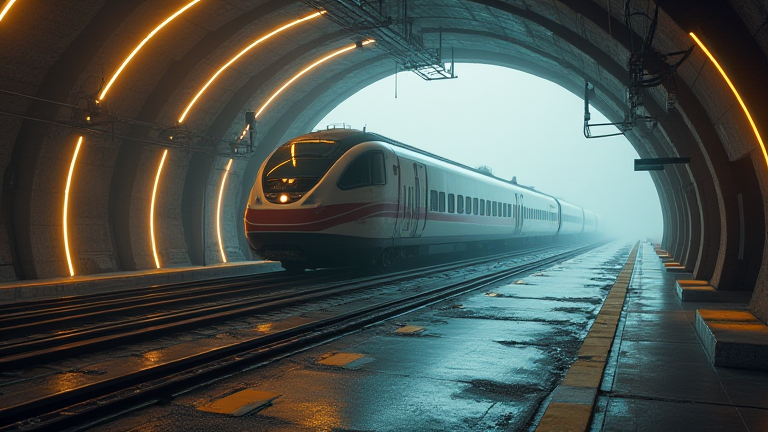
TL;DR: This title describes a physically impossible scenario for current rail technology, as no bullet train exists that can accelerate from zero to 800 kilometers per hour in merely five seconds. Such a feat would require extreme G-forces that would be lethal to human passengers and exceed the structural limits of existing track infrastructure.
The Reality of High-Speed Rail Innovation
While headlines may occasionally spark excitement with exaggerated claims about hyper-loop speeds or futuristic maglev prototypes, the current state of China’s high-speed rail network remains grounded in engineering reality. The Fuxing Hao, the pride of China’s railway system, operates at commercial speeds of 350 kilometers per hour, with experimental runs reaching up to 486 kilometers per hour. The notion of a train hitting 800 kilometers per hour in five seconds is not just optimistic; it defies the laws of physics regarding human tolerance and mechanical stress. A vehicle accelerating to that speed in five seconds would subject occupants to approximately 8.9 Gs, which would cause immediate unconsciousness and severe physical trauma. Therefore, such a claim is likely a misunderstanding of future maglev concepts or a complete fabrication designed to generate clicks rather than inform.
If you want to dig deeper, check out our guide on 2024 Trends: What’s Shaping the Future of SEO.
Current Technological Benchmarks and Industry Impact
The true innovation in China’s rail sector lies in efficiency, reliability, and incremental speed increases rather than record-breaking acceleration tests. The industry has focused on reducing travel times across vast distances through optimized routing and advanced aerodynamics. Recent developments include the introduction of smart trains equipped with AI-driven maintenance systems that predict failures before they occur. These advancements have significantly lowered operational costs and increased safety margins. Furthermore, the integration of 5G technology allows for real-time monitoring of train health and passenger connectivity, enhancing the overall user experience. The impact on the industry is profound, as it sets a global standard for high-speed transit that balances speed with passenger comfort and safety. Competitors in Europe and Japan are also pushing boundaries, but they too are limited by the same physical constraints. The race is not about who can accelerate the fastest in seconds, but who can maintain the highest sustainable speed over long distances with the lowest environmental footprint. This shift in focus ensures that high-speed rail remains a viable, safe, and popular mode of transport for millions of daily commuters.
FAQ
Q: Can a bullet train reach 800km/h in 5 seconds?
A: No, it is physically impossible for current technology due to lethal G-forces and infrastructure limitations.
Q: What is the current top speed of China’s high-speed trains?
A> Commercial speeds are 350km/h, with experimental records reaching approximately 486km/h.
Q: How does this affect global rail competition?
A: The focus has shifted to efficiency and safety standards, setting benchmarks for sustainable high-speed transit worldwide.