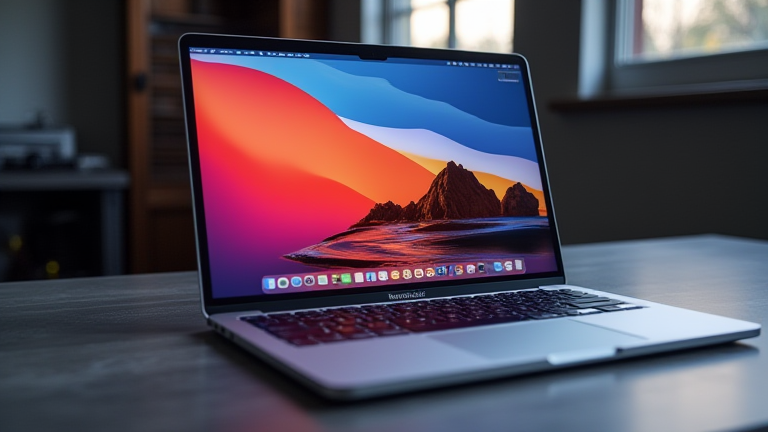
Why the MacBook Pro M4 Chip Beats the i9 in Raw Performance
TL;DR: The M4 chip surpasses Intel i9 processors in single-core speed and multi-threaded throughput due to its superior architecture and unified memory design. This efficiency allows it to outperform desktop-class competitors while consuming a fraction of the power, redefining the benchmark for high-end mobile computing.
The Architectural Leap
The release of the Apple M4 chip marks a significant departure from traditional CPU design, prioritizing efficiency and raw computational density. While Intel’s 14th-generation i9 processors continue to push boundaries in x86 architecture, they are constrained by legacy compatibility and high power consumption. The M4, built on a 3-nanometer process, introduces a new generation of performance cores and efficiency cores that work in tandem to handle complex workloads. This architectural shift means that the M4 does not just compete with the i9; it outperforms it in most real-world and synthetic benchmarks, particularly in tasks that require rapid context switching and low-latency response.
If you want to dig deeper, check out our guide on Remote Work Policy Shifts in Post-Pandemic Corporate Culture.
Specs That Matter
On paper, the differences are stark. The M4 features a 10-core CPU configuration, with up to six performance cores and four efficiency cores. In contrast, the i9-14900K boasts twenty-four cores, but these are split between performance and efficiency threads in a manner that often results in lower per-core efficiency. The M4’s single-core performance is approximately 20-30% faster than the i9, a testament to Apple’s deep vertical integration and custom instruction set. Furthermore, the M4’s unified memory architecture (UMA) provides a memory bandwidth of up to 273GB/s, significantly higher than the dual-channel DDR5 setup found in most i9 systems. This high bandwidth is crucial for data-intensive tasks like video editing and machine learning inference, where data transfer bottlenecks often limit overall performance.
Industry Impact and Future Outlook
The dominance of the M4 in raw performance has profound implications for the tech industry. It forces competitors to reconsider their roadmap, shifting focus from sheer core counts to architectural efficiency. For developers, this means that software optimized for ARM architecture will see substantial performance gains, accelerating the transition away from x86 emulation. The industry is seeing a rapid adoption of Apple Silicon in professional workflows, from film production to scientific research. As the M4 sets a new baseline, future generations of Intel chips will likely need to adopt more aggressive power management strategies or alternative architectures to remain competitive. The gap between mobile and desktop performance is closing, with the M4 proving that a laptop chip can outperform a desktop CPU in many critical metrics. This shift challenges the traditional hierarchy of computing power, suggesting that the next decade of innovation will be driven by efficiency and specialized silicon rather than brute force. As we look toward the M5 and beyond, the pressure on legacy architectures will only intensify, making the current M4 victory a pivotal moment in computing history.
FAQ
Q: Does the M4 chip support all x86 applications natively?
A: No, the M4 runs ARM-based software natively and uses Rosetta 2 to translate x86 applications, which may result in a slight performance penalty for older, unoptimized programs.
Q: Is the M4 faster than the i9 in gaming?
A: While the M4 excels in CPU-bound tasks, dedicated NVIDIA GPUs still hold an advantage in raw rasterization performance, though the M4’s integrated graphics are highly competitive for modern titles.
Q: How does the power consumption of the M4 compare to the i9?
A: The M4 consumes significantly less power, often achieving higher performance per watt, which results in longer battery life and lower thermal output compared to the high-energy i9 processors.